How OilCare® turns used cooking oil into a measurable sustainability contributor
For multi-location foodservice operators, sustainability goals are no longer aspirational. They’ve become measurable business objectives that require documented results. Whether they’re driven by corporate ESG initiatives, customer expectations, or other commitments, organizations are under growing pressure to quantify the impact of their environmental efforts. Those measures need to be consistent across dozens or even hundreds of stores.
Used cooking oil (UCO), when effectively managed, can be a significant contributor to corporate environmental initiatives while also acting as a revenue stream. UCO is prime for recycling — which brings with it monthly rebates — into biodiesel, which has proven, measurable offsets for greenhouse gas (GHG) emissions.
OilCare®, a sister service company of Frontline International, helps simplify the process of managing, recycling, and benefiting from foodservice FOG (fats, oils, and grease). Among the benefits is smarter, more transparent management of used cooking oil.
Here is how OilCare helped an actual customer that moves cooking oil through hundreds of locations in 10 states.
Before contracting with OilCare, each store in the chain handled its oil in slightly different ways. UCO pickups, rendering rebates, vendor coordination, reporting, and environmental claims were hard, if not impossible, to track consistently.
Enter OilCare
The chain contracted OilCare to manage its used cooking oil collection. OilCare installed the infrastructure — Frontline International’s Direct-Plumbed® used oil collection tank and M3 data management system — and also manages the oil stream, coordinates service, and tracks collections through M3. OilCare has turned each UCO pickup into measurable operational, financial, and environmental data.
The program started small and has ramped up to nearly 100 stores. Because the chain is experiencing rapid growth, it elected to roll out OilCare among newly built locations, with an intention to circle back to legacy stores during a future period of retrofit.
As more stores have come online with OilCare, the chain’s KPIs have evolved. GHG reduction has become increasingly important. The chain can see gallons collected, renewable diesel displacement, carbon impact, location participation, service history, and rebate dollars returned. The more stores that are added, the bigger the results become. The bigger the footprint, the more powerful the compounding effect.
Each store uses the same Frontline International equipment, a 150-gallon used oil containment tank (Model 2478SQ) that is Direct-Plumbed, meaning used oil runs directly from the fryer vat to the UCO tank through fully enclosed piping. It is 100% hands-free and automated.
OilCare has built-in data management
All OilCare UCO management services come with Frontline International’s data management system built in. M3 (Monitor, Measure, and Manage) enables organizations that operate across multiple markets to see the cumulative impact of their oil management program through meaningful metrics.
Organizations can easily translate this data into total gallons of used cooking oil recovered, greenhouse gas emissions reduced, equivalent vehicles removed from the road, equivalent household energy usage offset, and revenue and rebates generated.
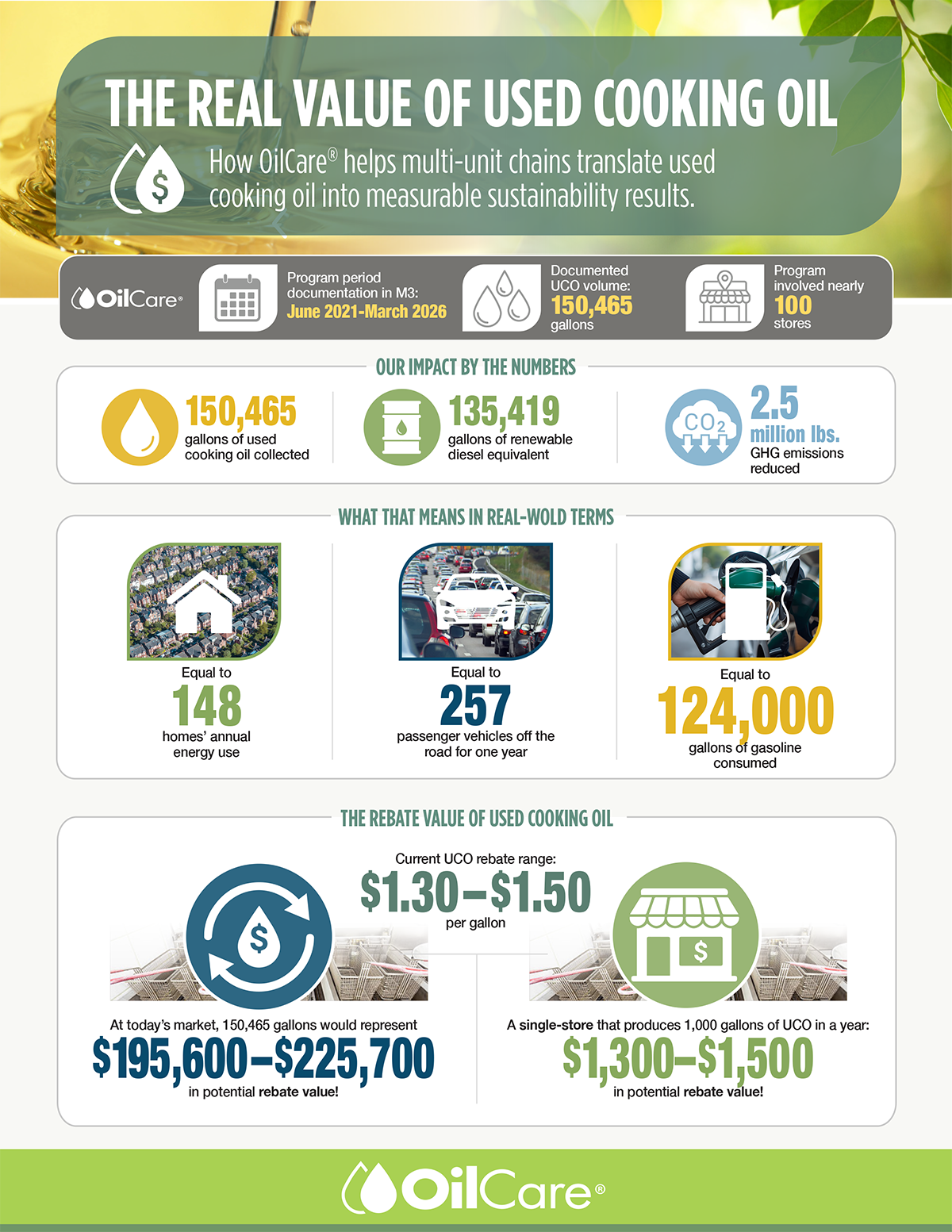
For this customer, OilCare tracking via M3 clearly shows how the chain’s UCO recycling program has resulted in a reduction of nearly 2.5 million pounds of GHG emissions since the program began. Further, the chain can easily see how much each location is contributing to the reduction.
The calculation is a simple one. Each gallon of regular diesel fuel contributes 22.45 pounds of carbon dioxide to the atmosphere, while each gallon of biodiesel contributes just 4.49 pounds. M3 determines how many gallons of biodiesel the customer’s collected UCO creates, resulting in the total figure for GHG reductions.
The chain’s nearly 2.5 million pounds in total reductions is equal to 148 homes’ annual energy use, removing 257 passenger vehicles from the road for one year, or 124,000 gallons of gasoline consumed.
A secondary revenue stream
In addition to this clear environmental benefit, the OilCare-managed UCO program is also putting money back into the chain’s coffers via rebates for recycling the used oil.
“The rebates are calculated based on volume and the market rate,” said Zack Palazzo, vice president of sales and finance for Frontline International. “The markets are extremely high right now, so OilCare customers are seeing around $1.30 to $1.50 per gallon for their used cooking oil with our program.”
For a single store, that can turn used oil from a necessary disposal item into a recurring revenue stream. A location producing 1,000 gallons of used cooking oil in a year could return approximately $1,300 to $1,500 at today’s market rates. At 2,000 gallons annually, that same store-level opportunity rises to roughly $2,600 to $3,000.
For a multi-unit chain, the value compounds quickly. Across the locations currently tracked in M3 for this customer, OilCare has documented more than 150,000 gallons of used cooking oil collected. At today’s elevated rebate range, that volume would represent approximately $195,000 to $226,000 in potential rebate value.
Even using a more conservative blended value of $1.00 per gallon across the program period documented in M3, the chain’s collected UCO would represent approximately $150,000 in potential rebate value.
That number will fluctuate with the market, but the larger point is consistent: used cooking oil has measurable value, and multi-unit operators need a system that helps them capture it.
“Used oil has always had value, but many operators have not had a clear way to see that value across their full organization,” Palazzo said. “OilCare gives them a way to manage the material, track the collections, document the environmental impact, and understand the financial return.”
That combination of operational control, sustainability reporting, and rebate recovery is where the OilCare model becomes especially valuable for chains. Instead of relying on store-by-store estimates or disconnected vendor records, the customer can see actual collection activity and cumulative results.
For operators under pressure to document sustainability progress, those results matter. For operators focused on profitability, the rebates matter, too.
OilCare brings both sides together.
“Every gallon matters,” Palazzo said. “When you multiply that across dozens or hundreds of units, the impact becomes much bigger than most operators realize.”
For multi-unit brands, the lesson is clear: used cooking oil is not just a waste stream. With the right infrastructure, service model, and data platform, it becomes a measurable contributor to sustainability goals and a recoverable source of value.